Sunday, 8 March 2015

Lamborghini Veneno: All beast, no bull

Lamborghini Veneno: All beast, no bull


A tribute to Automobili Lamborghini on the occasion of its 50th birthday, the Veneno is the ultimate party favour.
Derived from the overachieving Aventador, the arrow-shaped Veneno pushes the performance envelope even further. The car makes use of the Aventador’s mid-mounted 6.5-litre V12, bumped from 700hp to 739hp, and drives all four wheels through a 7-speed automated manual gearbox. Its chassis, featuring an inboard pushrod suspension bolted to a carbon fibre monocoque structure, is pure prototype racer, but Lamborghini is proud to note that the Veneno meets all worldwide road-car safety and registration requirements. Top speed is a breezy 220mph. (For those keeping track, the Aventador is good for 217mph.)
The Veneno is a sequel of sorts to the Gallardo-derived, and similarly futuristic, Sesto Elemento show car from 2010. But whereas Lamborghini said it would craft 20 examples of the Sesto Elemento, the automaker plans to build just three Venenos during 2013, priced at a cool 3 million euros each (at writing, about $4.1 million, plus tax). And before you get your hopes up, the company has already found buyers for its triplets, save the one on the Geneva motor show stand – chassis number 0, whose future, to quote Lamborghini, has not been determined yet.
As for the name, Veneno, according to the company, was the name of a particularly bad-tempered and fearsomely fast Spanish fighting bull who gained notoriety in 1914 for goring bullfighter José Sánchez Rodríguez to death. A vicious pedigree for a vicious machine.

The boss’s girlfriend, your problem

The boss’s girlfriend, your problem

(Credit: Thinkstock)
Q. My boss is newly divorced, he's promoted a very young intern into a responsible role and he's begun dating her. Now he's assigning considerable amounts of other employees' time to her projects, which the rest of us, in our professional opinions, don't think are worth it from a business perspective. What should we do?
A. How awkward for the whole office when people take unflattering stereotypes as a script. Your boss is free to run his private life as he wishes, but bringing this type of behaviour to work is, as you note, a poor choice on his part. (In fact, some companies prohibit senior-junior relationships, so it’s possible he’s breaking the rules and not just violating standards of ethics.)
Plenty of bosses sense great things in a young colleague and promote that person rapidly in a bid to help him or her develop important professional skills. When that happens, others on the team often grumble about how they’ve been passed over. That’s just complaining, unless what the boss sees in the young protégé  is something entirely separate from career promise.

Farm Atv that could revolutionize the Agricultural sector

FarmDogg blends robotics with rutabagas

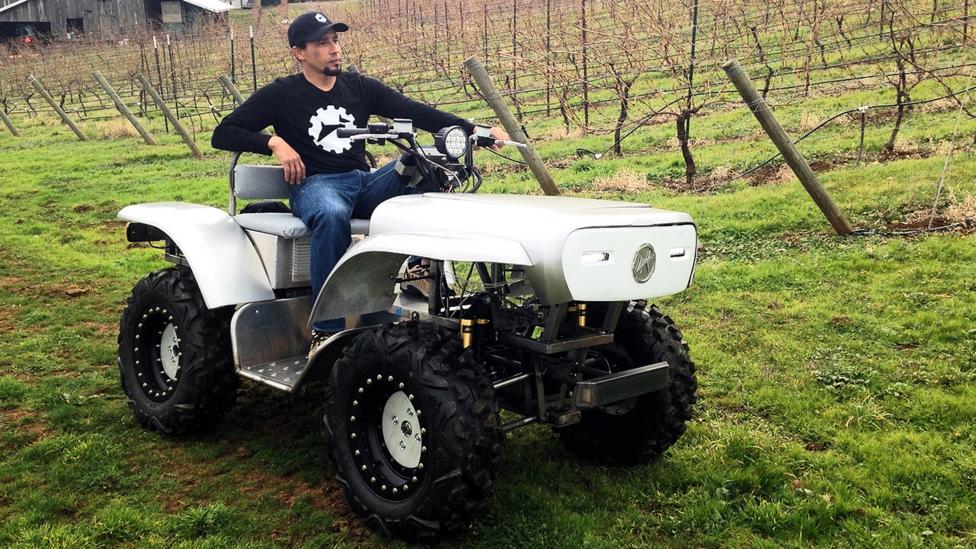
(Credit: Rogue Rovers)The 550lb (250kg) vehicle measures seven feet long (213cm), four feet wide and slightly more than four feet tall. It features a lightweight plastic body that covers a frame made of square-tube steel, which allows for easy addition of work-tool attachments. Other end-user considerations include an easy-on, easy-off seat, a lower center of gravity to retain stability on inclines and – here’s the computing part – a cloud-based smart-technology platform called DoggBone, which allows data collection and robotic operation, Brandao says.
Commercial ATV users who don’t love the vehicles’ loud engines and bone-rattling vibrations might embrace the FarmDogg’s two whisper-quiet 5kWh hub motors, one in each rear wheel. A 3.2kWh lithium-ion battery pack supplies the power; it can be expanded into a 6.4 kWh pack. Maximum range is about 40 miles (64km), Brandao claims, with a top speed limited to 20mph (32 km/h).
The DoggBone interface would enable the vehicle to follow farmers like a loyal farm dog as they perform routine jobs such as spraying or harvesting crops. In a more advanced mode, the vehicle could be instructed to spray fertilizer on trees at an orchard, but perhaps only on every other tree, for example,Brandao notes.(Credit: Rogue Rovers)
“You can create other modes of activity: mowing, tilling and snowblowing can all be automated,” she adds. “The robotics technology is there. The problem is there hasn’t been as much focus on applying it toward commercial applications. That makes the FarmDogg more than just a single-operation piece of equipment and helps farmers justify buying one.”

Friday, 6 March 2015

Hay and Pellets

Hay and Pellets

Download

What do you feed a bunny?

Most people think pellets and a carrot now and then are the only food a rabbit needs. But guess what the most important part of your rabbit’s diet is...hay! (We cover pellets later in this section too!)
rabbit eating hay Hay is important for rabbits for many reasons. When a rabbit munches a nice green pile of hay, she:
  • Wears down her teeth that are constantly growing
  • Gets lots of great fiber to keep things moving through the digestive tract
  • Keeps herself busy rearranging it and searching for the best tasting pieces
  • Learns and keeps good litterbox habits
A rabbit’s digestive system is one of balance. She needs the right nutrients moving through to supply her body with energy, growth, and healing ability, and quality hay provides these nutrients. Hay mimics what a wild bunny eats — grasses she finds growing all around her. And like cats, bunnies groom themselves by licking their fur. But while cats can spit up a hairball, a rabbit can’t! Her system is one-way, so having bulky fiber pieces from hay keeps things moving right on through. A serious medical problem for a rabbit is a blockage in her digestive system, whether from fur, munched carpet fibers, or just a dehydrated food mass. The surest way to prevent one of these health scares is to provide unlimited grass hay to your rabbit to keep things moving!
Chewing motions are different for different foods—pellets, hay, vegetables. Some use side-to-side motions and some use up-and-down. When you provide hay in your rabbit’s diet along with pellets and veggies, you maximize how well her teeth get used to help keep them healthy and trimmed evenly.
One of the best places to put a big pile of hay—and we’re talking a pile the size of your rabbit!— is in the end of the litterbox. Bunny likes sitting in a cozy box, especially one with tasty hay at the end! She can munch from the pile while doing her litterbox business at the other end. This is great training and keeps that cage clean! Hay is also entertaining for a rabbit—she will rearrange it, dig in it, and throw it around to find the best taste or to have it feel just the way she wants it for a nap. A bunny who isn’t bored doesn’t get in as much trouble chewing on your house! Another hay toy: stuff it in an empty toilet paper tube. Most bunnies think it tastes even better that way and it makes a great toss toy, too!

Where do you find quality hay?

timothy hay An adult rabbit needs a quality grass hay always available. Grass hays include timothy, orchard grass, bermuda grass, and others. You can find grass hays in pet stores, from horse farms or feed stores, at vet offices who specialize in bunnies, or online from pet hay suppliers. The trick is to find a good hay. Look for a green, fragrant hay. Most rabbits like soft kinds best, but having a mix of stalks and soft parts is great for providing the different kinds of bulk fiber that are good for teeth and digestive systems. Don’t buy hay that is all brown, dusty, has visible mold, or smells moldy. Dusty/moldy hay is dangerous for a bunny!
The most important part of a good hay is one that your bunny will eat. If you find a huge bale of timothy for $4 and bunny loves it, great! But if bunny won’t eat it, it just won’t do her any good. Picky bunnies often love Oxbow Hay brand, which can be found in some pet and feed stores, online pet suppliers, and at Oxbow Animal Health. If you can’t find it locally, ask your pet supply store to order it for you or to start carrying it!

What about alfalfa hay?

Alfalfa hay is high in protein and minerals like calcium, which can be too rich for your bunny to eat all the time, causing health problems like obesity and bladder stones. Alfalfa is great for a baby or growing bunny, but an adult bunny usually needs a grass hay like timothy, or a mixed grass hay that is mostly timothy but might have some alfalfa in it. Most bunnies do like the taste of alfalfa better, so you might tempt a picky bunny with it first and then switch him to timothy by mixing the hays together for a while.

Okay, okay, my bunny needs lots of hay! But what about pellets?

Yes, pellets are part of a rabbit diet too. It’s possible to feed a non-pelleted diet, but this requires a careful balance of nutrient sources from many types of veggies and hay. Most rabbit owners prefer to provide a pelleted food in addition to the hay and vegetables their rabbit eats.
Pellets are made from hay. They are also balanced with nutrients your bunny needs that might not be in a particular bale of hay depending on where it was grown or how the weather was that season. It’s important to pick a quality pellet. Look for one that is plain—no colored pieces, crunchy puffs, seeds or nuts in it. Look for higher fiber and lower protein. Ask your bunny vet for a recommendation. And most importantly, don’t feed too much!
You will need to ration the pellets for most adult rabbits. If you don’t, they tend to overeat and get fat, and when they are full from pellets, they don’t eat enough hay! A common portion is ¼ to ½ cup daily for a 5 to 7 pound adult rabbit. Rabbits who need to lose weight will need more restricted pellets and more exercise. Baby or growing rabbits, or sick bunnies needing to gain weight, should be served unlimited pellets along with their piles of hay and their veggies.

GB Olympic legend Victoria Pendleton makes surprise sport switch


View gallery
.
Victoria Pendleton (Reuters)

They say sport stars never lose their competitive spirit and that can certainly be said for former Great Britain Olympic stalwart Victoria Pendleton.
The British cycling legend appears to have been itching to get back into competition, and more specifically into a saddle again.
Now 34-years-old, Pendleton has begun her intensive training to become a jump jockey, with the goal of competing in the Foxhunter Chase at next year's Cheltenham Festival.
With her change of career funded by bookmakers Betfair, she has been working with National Hunt trainer Paul Nicholls and Team GB's eventing performance manager Yogi Breisner for the project.
It is certainly a big surprise to see Pendleton taking on a serious sporting challenge in a completely different discipline - one which she has no top-level experience in.
View gallery
.
Victoria Pendleton (screenshot)
But she believes that her natural competitive spirit and mental discipline from securing sprint gold at Beijing in 2008 and the keirin at London 2012 will stand her in good stead.
"I've been looking for a new and exciting challenge, and when they approached me about the opportunity to become a licensed amateur jockey, it captured my imagination," she told the Daily Mirror.
"I’m motivated by the scale of the challenge and the opportunity to combine my love of horses with learning a new skill under the guidance of racing experts put together for me."
View gallery
.
Victoria Pendleton (screenshot)
Nicholls added: "Having the competitive mindset of an Olympic champion will, I've no doubt, put her in a great place to succeed in this challenge whilst shining a much-deserved light on the sport of horse racing."
It will certainly be intriguing to see if Pendleton can transfer her success on the saddle of a bike over to the saddle on a horse.
As we've revealed in a previous feature, sometimes stars do not make the most predictable or logical career changes after succeeding in their original chosen sport - however, we hope Pendleton manages to succeed yet again.

Apple to Replace AT&T on DJIA

Apple Inc, the largest U.S. company by market value, will join the Dow Jones Industrial Average on March 18, replacing AT&T Inc, S&P Dow Jones Indices said on Friday.
With a market capitalization of about $736 billion, Apple is the largest publicly traded company in the world. AT&T, by contrast, has a market value of $176.5 billion.
The iPhone and iPad maker had been notable by its absence in the 30-stock average, and it had been excluded because its stock price was too high for the price-weighted index. The move by S&P Dow Jones Indices had been widely anticipated since a seven-for-one stock split in June 2014.
"This is a sign of the times, and it might get everyone to look at the Dow more than they have been," said Richard Sichel, who oversees $2 billion as chief investment officer at Philadelphia Trust Co.
"It would be difficult to pick any 30 companies that would cover the entire economy, especially compared with the S&P 500, but it does give the Dow more credibility."
In premarket activity, shares of Apple were higher, gaining 1.4 percent to $128.15, while AT&T's shares fell 1.4 percent to $33.53.
Since its split, had Apple been substituted for 29 of the 30 Dow components last June, the index would have been higher. Visa is the only Dow component that would have helped the Dow more during that time, in part because of its high stock price.
S&P Dow Jones Indices said that Visa's impending four-for-one stock split will reduce its weighting in the Dow. Despite Apple's size, it would currently only have a 4.66 percent weighting in the Dow because of its price, the index company said in a statement.
AT&T has had two stints in the Dow. It was added in 1916 and removed in 2004. After SBC Communications renamed itself AT&T following a 2005 merger, it was reinstated in the index. (Reporting by David Gaffen and Ryan Vlastelica; Editing by Dan Burns and Bernadette Baum)
Apple
Image result for rabbit feeds


What to Feed Your Rabbit

Jan 10, 2013 by
Print Friendly
Large, unlimited amounts of fresh hay should be offered daily. Young bunnies should be introduced to hay as soon as they can eat on their own. Mixed grass hay or Timothy hay is preferred because it is lower in calories and calcium than alfalfa.
Use a good quality, high fiber alfalfa or timothy based pellet as a small part of your rabbit’s diet.
Feed a minimum of 1 cup vegetables for each 4 lbs. of body weight. Select at least three types of vegetables daily. A variety is necessary in order to obtain the necessary nutrients, with one each day that contains Vitamin A, indicated by an *. Add one vegetable to the diet at a time. Eliminate if it causes soft stools or diarrhea.
Limit fruits to 1-2 tablespoons per 5 lbs. of body weight (none if dieting) from the list below of high fiber fruits. Sugary fruits such as bananas and grapes should be used only sparingly, as occasional treats. Bunnies have a sweet tooth and if left to their own devices will devour sugary foods to the exclusion of healthful ones.
Vegetables:
Alfalfa, radish & clover sprouts
Basil
Beet greens (tops)*
Bok choy
Broccoli (mostly leaves/stems)*
Brussels sprouts
Carrot & carrot tops*
Celery
Cilantro
Clover
Collard greens*
Dandelion greens and flowers (no pesticides)*
Endive*
Escarole
Green peppers
Kale (!#)*
Lettuce: Romaine, Red or Green leaf (no iceberg or light colored leaf)*
Mint
Mustard greens*
Parsley (!X)*
Pea pods (the flat edible kind)*
Peppermint leaves
Raddichio
Radish tops
Raspberry leaves
Spinach (!#)*
Watercress*
Wheat grass

Apple
Blueberries
Melon
Orange (including peel)
Papaya
Peach
Pear
Pineapple
Plums
Raspberries
Strawberries


Absolutely NO chocolate (poisonous!), cookies, crackers, breakfast cereals, bread, pasta, yogurt drops or other “human treats.” There is research to suggest these items may contribute to fatal cases of enterotoxemia, a toxic overgrowth of “bad” bacteria in the intestinal tract.